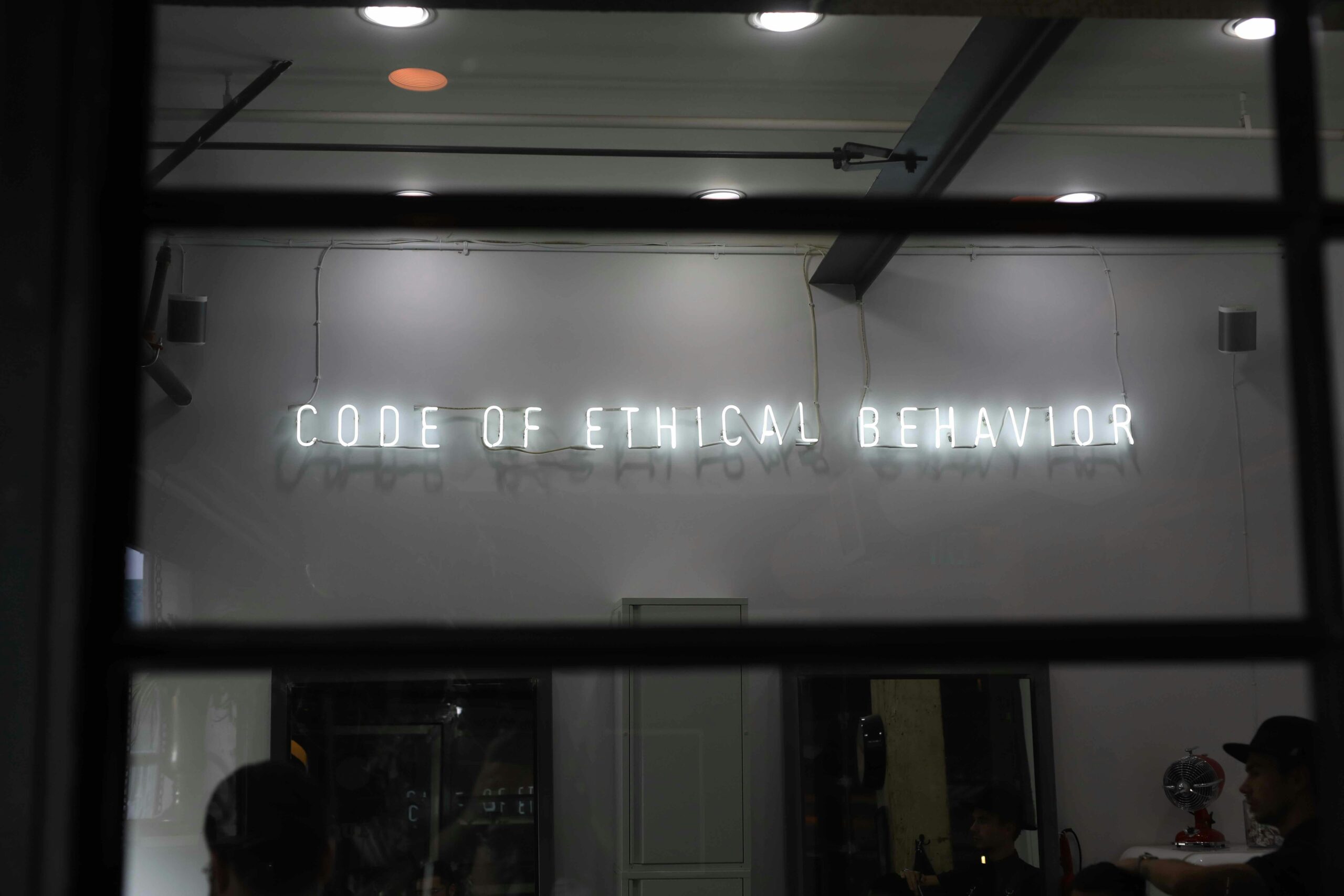
Ethics in the modern world has changed considerably since the time of the Greek philosophers who formed their ethical codes and guidelines for being a virtuous person and living the ‘good life’ a’ la Plato and Aristotle’s virtue ethics for instance. However, there are many similarities with these ancient viewpoints and many of the maxims can still be applied today, particularly in relation to developments in AI and technology. Having an ethical code is more important than ever as we navigate these fast-changing and exciting times.
What exactly is ethics and why does it matter? Ultimately, ethics is a set of behavioural traits which determine our actions according to a moral code. In philosophy, ethics observes the moral principles which drive our behaviours and how we decide what is right or wrong. One could argue that ethics is putting words to our hunches, tapping into our innate sense or conscience. As with all theories, there are many grey areas and many instances where the supposed right and wrong actions may contradict one another; for example, lying to protect a friend may be perceived as being ‘wrong’ initially, yet the motive is favourable. It may be that seemingly opposing options could be equally correct courses of action depending on the context.
Video: Coverr
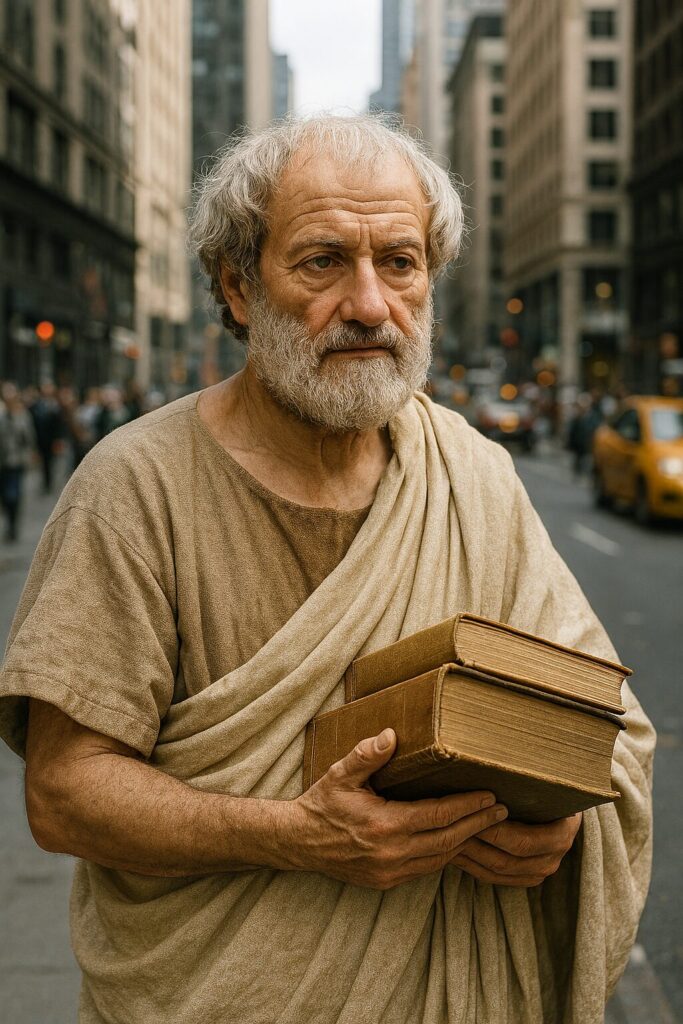
Aristotle posits that a person who acts morally must also be of sound moral character. He created a framework for this virtuous character as living the ‘middle way’ – for example, not being too timid or too arrogant, too cowardly or too rash. He calls this middle way the ‘golden mean’. The idea is that if we cultivate such a character, we would naturally make good moral choices from this standpoint. This, he argued, was the roadmap to achieving the ‘good life’ or eudaimonia – a state of living consciously and virtuously according to one’s cultivated goodness. He stated in his infamous Nichomachean Ethics: ‘the good for man is an activity of the soul in accordance with virtue’.
In the modern day, ethical issues are arising all the time, yet we are in many ways far from living the good life as Aristotle had in mind. Current ethical debates are centered on wealth, health, immigration, medicine, and the extensive use of AI technologies in human development among countless others. How can we be pursuing wealth when many nations are struggling? Why are we focusing on AI when there are more pressing issues that may need attention? Many of these modern day ethical issues stem from contrasting purposes and motivations of those in positions of power.
Why are we focusing on AI when there are more pressing issues that may need attention? Many of these modern day ethical issues stem from contrasting purposes and motivations of those in positions of power.
This is also a troubling issue with having a unanimous moral code which works for everyone – we all come from a different standpoint, with differing worldviews and priorities.
So what solutions can we come up with? Can a philosophy of ethics help us to tackle global issues or will we end up in another rabbit hole? There are three main branches of ethics in philosophy; normative ethics (developing a framework in order to determine which actions are right or wrong); applied ethics (applying these principles to everyday issues) and meta-ethics (evaluating where these judgements come from in the first place – for example, why is it important to even have a moral code in the first place?). All three are necessarily required in order to come to any conclusion. (…and incidentally, you might like to read other articles on similar subjects after this one)
Initially, it would need to be decided what is important to focus on – it may be considered that basic human rights is a vital tenet to begin with; that we are all entitled by birthright to certain privileges such as shelter, food and freedom of speech.
From there, it may be inferred that resources ought to be distributed among all people equally. Okay, but what about socialism? What about those who work harder than others, should they be entitled to more resources? As you can see, this ends up being a discussion of politics and value.




Let’s say that we all do indeed value human rights, we would then need to formulate a framework that supports this maxim. For example, all humans have the right to food and shelter. Any instance where this was not the case would need to be corrected. Kant argued for creating such maxims in order to then check events and disputes against. Nevertheless, although this works in theory, what happens when resources are depleted, or the maxim cannot be fulfilled?
A person without ethics is a wild beast loosed upon this world.
Albert Camus.
It may be contended that ethics is a loose framework and we can all simply do our best to aim towards it. After all, many of us make promises to give up chocolate, go to the gym more or get up at 5am every day; however we often fall short of our intentions. Despite this, the fact that we have these intentions set up means that we are edging closer towards them than if we didn’t have an intention or resolution at all.
Similarly, if there were no ethical codes, perhaps the world would be even more anarchic – there would be no framework to rebel against or to fall short of. In essence, we need ethics to provide us with a sense of a boundary; that boundary may be loose or fluctuating and even in disagreement with another’s, but this does not mean to abandon the boundary.
It means constantly refining and cultivating our ethical frameworks and personalities. If we are ever to reach eudaimonia, as the Greeks so emphatically postulated, we must constantly work on ourselves. It’s okay to make mistakes, to clash with different values and to create new maxims. We are edging closer to a more ethical system the more we work together, openly discuss ideas and imagine potential future scenarios. Working with AI in a healthy, humanist and positive way will mean that we do our best with the information we currently have. This is how revolutions happen, how science and predictions change, move and grow.
The beautiful take-away here is that we can make changes towards a better future right now, starting with ourselves in our communities. We can cultivate our virtuous personas by helping our neighbours and taking action in the community around us – are there groups we can get involved with? Are there community projects that need a boost? Every tiny action leads to a more peaceful and ethical world and it all starts with ourselves. As Aristotle famously remarked: ‘we are what we repeatedly do. Excellence, then, is not an act, but a habit’.
© 2025 Houghton & Mackay. All Rights Reserved. The content in this publication may not be reproduced in any form without prior permission to the rights owners. Prose by Emily Rose. Header Image by Nathan Dumlao. Learn more about Houghton & Mackay on the main Business Website.








1 thought on “ETHICS IN THE MODERN WORLD: WHERE DO WE STAND NOW?”