A WALKING TOUR OF EL GRECO’S TOLEDO. Moving through the streets and spaces that shaped his vision.
By Karyn Farrell: Columnist (UK)
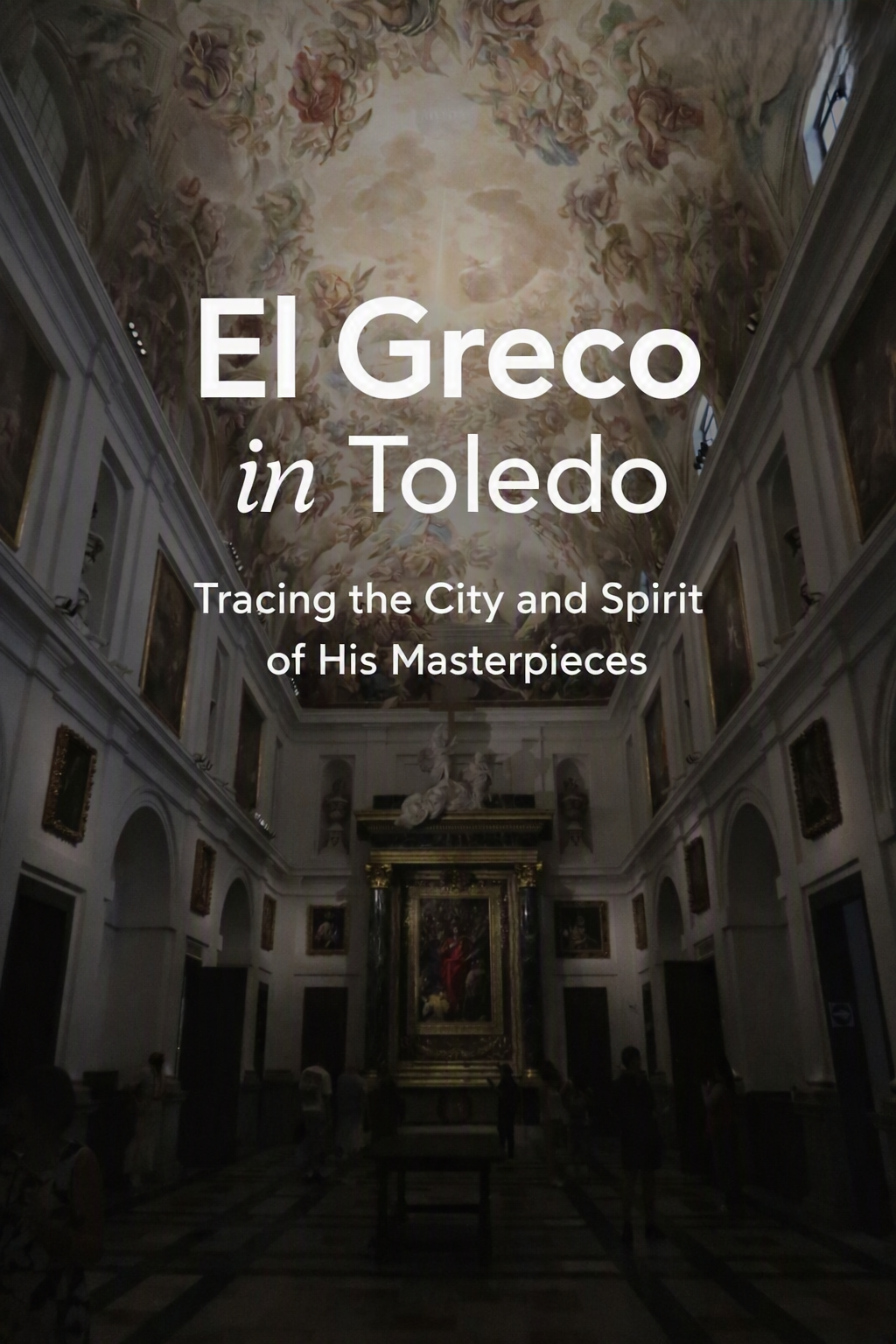
In the sacristy of Toledo Cathedral, the eyes of the apostles look down on the heads of visitors, inviting them to come closer. Thirteen portraits line the walls, each one distinct and individual. The canvases hang unglazed, the artist’s expressive, loose brushwork visible at close range. Each portrait is cropped to half-length, the figures pushed close to the picture-plane, creating an intimacy of experience. Eyes filled with emotion draw us closer, inviting connection on a deeper level. Profoundly affecting and human, there’s an emotional intensity to these late works: an artist at the pinnacle of his career.
Born on the island of Crete in Greece, Doménikos Theotokópoulos (1541–1614) is universally known as El Greco. After years spent living and working in Venice and Rome, a commission for a series of paintings for the Monastery of Santo Domingo brought him to Toledo in 1577. This beautiful small city became his spiritual home for the latter decades of his life. Here, his creative freedom was given full reign, resulting in some of his most powerful and original works. These can be found in numerous locations throughout the city.
Toledo’s 13th century cathedral is a good place to start, a veritable treasure trove of art and architecture with twelve unique chapels. With so much to see, the sacristy could easily be missed but is one of its greatest highlights. With an art collection including works by Goya, Caravaggio and Titian, and a vaulted ceiling hosting an elaborate fresco by Luca Giordano, El Greco is in good company.
His monumental commission The Disrobing of Christ dominates the long narrow gallery space, taking pride of place in an elaborate gold frame. Time spent in Rome and Venice left an indelible mark on his style. The debt to Michelangelo is unmistakeable, while the vibrant colour palette of Titian, Tintoretto and the Venetian School remained an influence on his work for the rest of his life. Using contrasting primary colours to dramatic effect, he created one of the great masterpieces of his career. At its heart stands the figure of Jesus, clad in red. A man in yellow prepares the crucifix while his tormentors remain in darkness. The compressed space and perspective heighten the psychological intensity of the scene, while the elongated proportions and twisted poses showcase his signature Mannerist style. The fusion of artistic influences combines to unleash his full expressive power.
María Zambrano — Influential Spanish philosopher and essayist. “Toledo gathers centuries into a single gaze.”
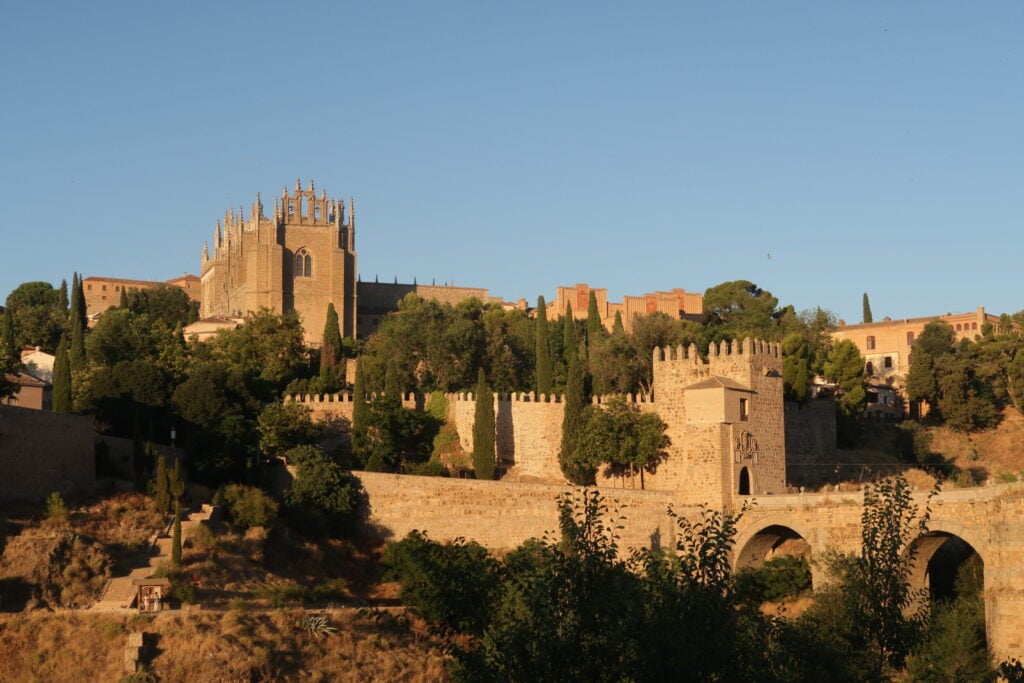
The Judería (Jewish Quarter) of Toledo is where El Greco lived and worked for the latter part of his life. With a long history of Jews, Moors and Christians living and working peacefully alongside each other, its striking Mudéjar architecture bears testament to this, fusing elements of all three cultures.
Buildings of pale stone line its narrow, cobbled streets, their façades adorned with elegant tile and brickwork in ornate geometric patterns. By the time the artist arrived in Toledo, this peaceful coexistence of cultures had come to an end.
With the instigation of the Spanish Inquisition under Queen Isabella I and King Ferdinand II, all Jews and Muslims had been expelled from Toledo by 1492.
Today, the Judería remains one of the most attractive parts of the city and is home to the wonderful El Greco Museum, a permanent homage to the artist. Celebrating the life and work of the city’s adopted son, the museum opened in 1910 and houses a key collection of paintings from his late period, when he produced what is arguably the best work of his life.
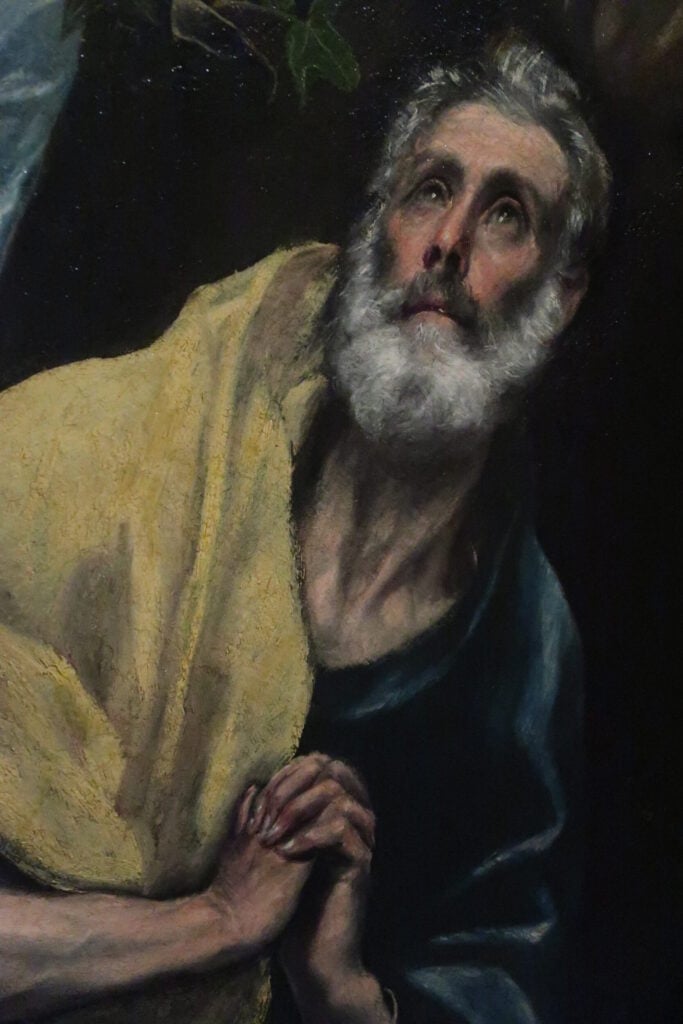
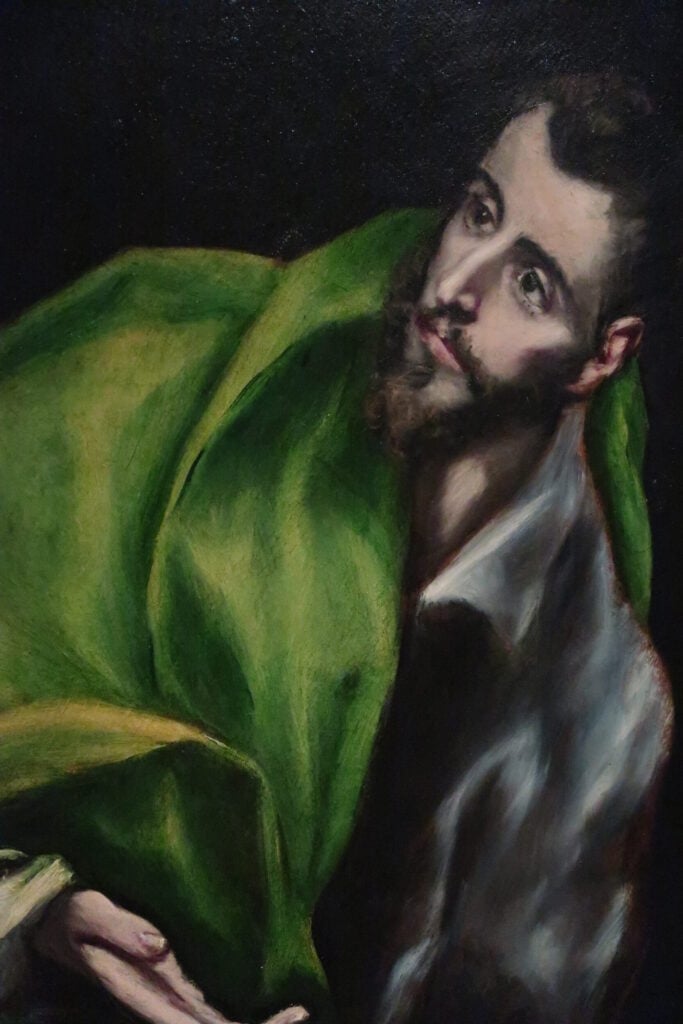
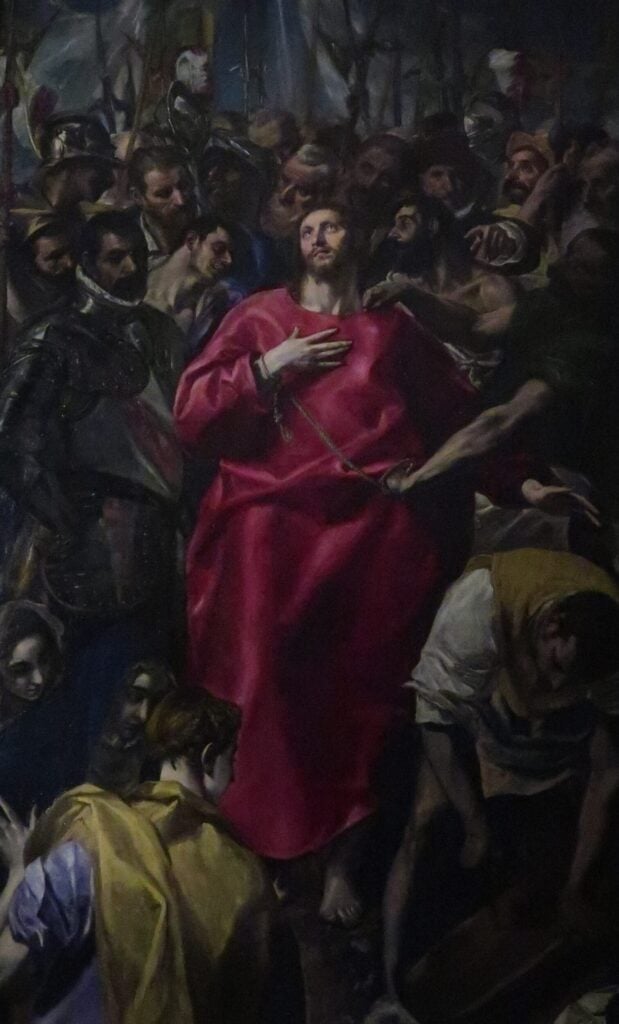
Clockwise: Immaculate Conception Santa Cruz, Tears of St.Peter, St James the Elder, Disrobing of Christ, Museo El Greco, Photography by Karyn Farrell
The Museo El Greco
where Toledo’s soul feels closest to the artist
— a quiet place where his late masterpieces still breathe
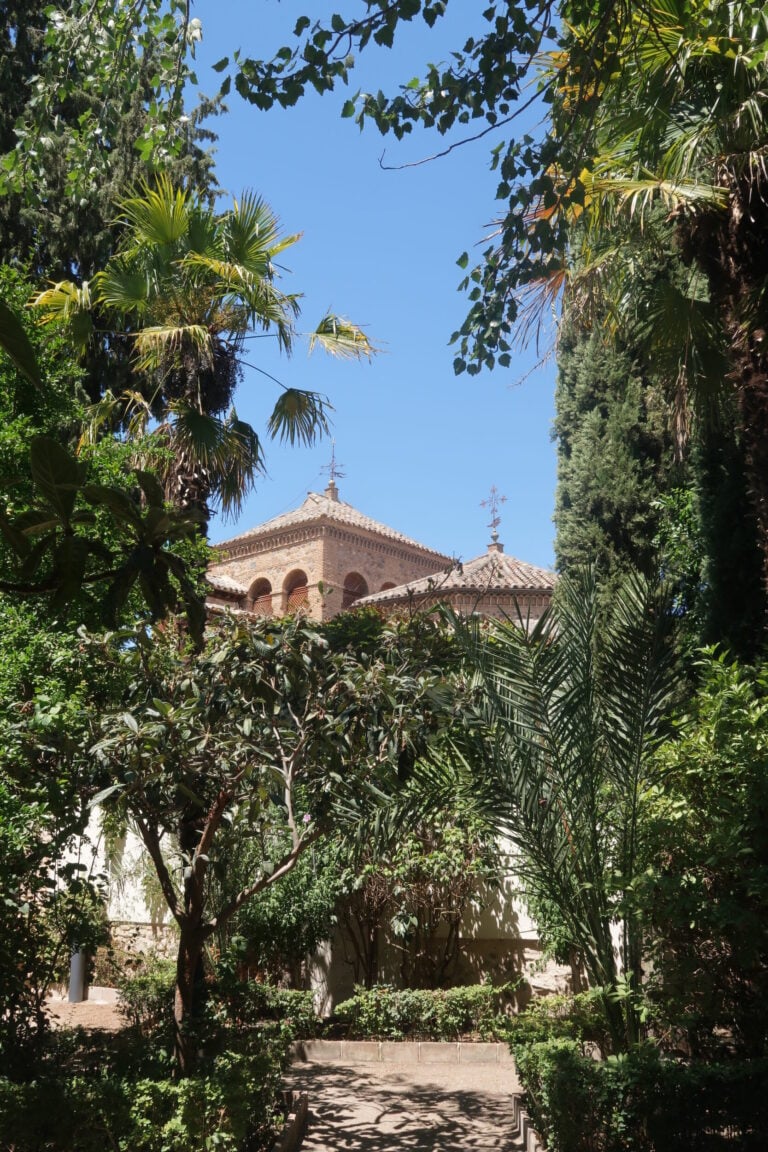
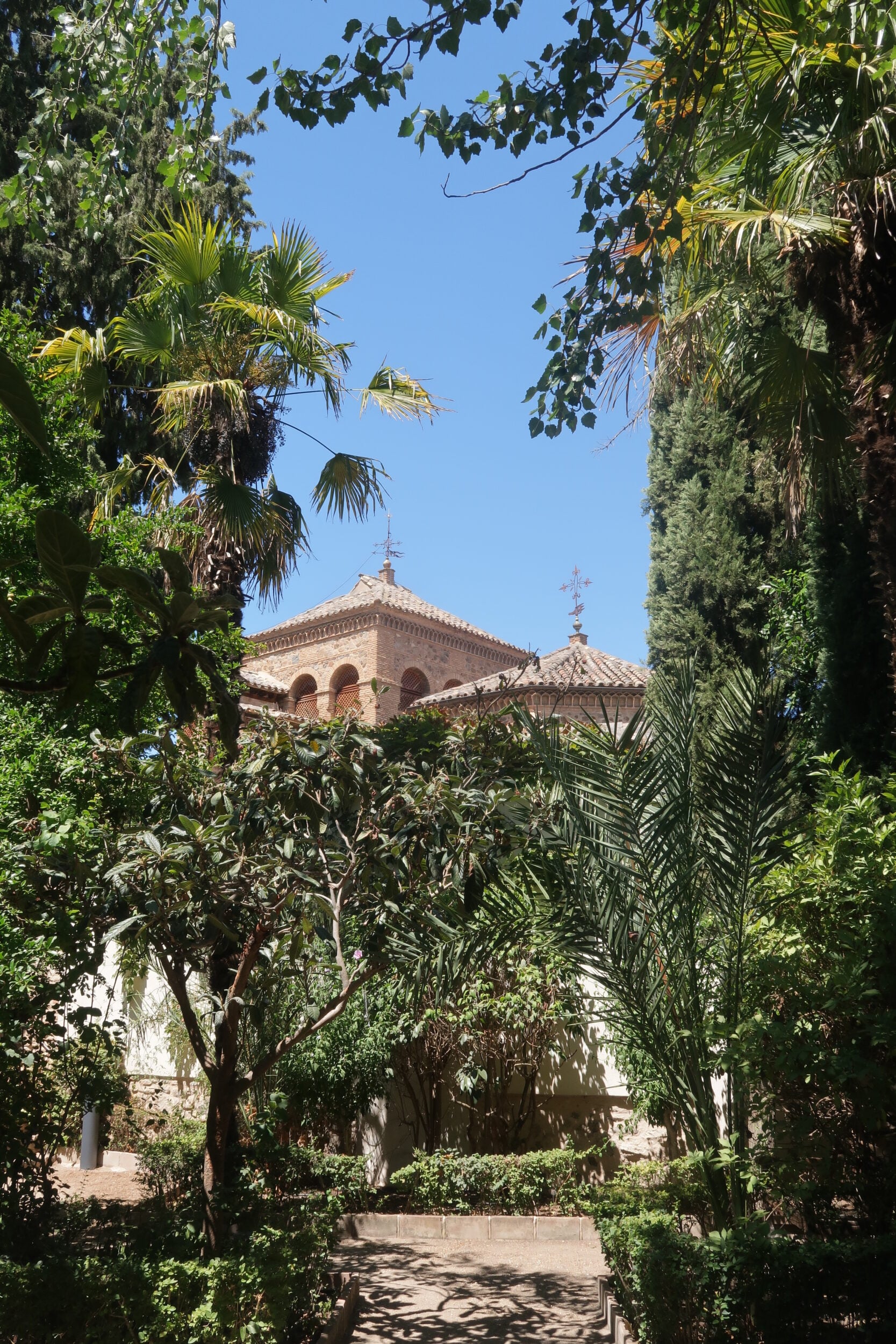
Located close to the property where the artist lived, the building is divided into two parts: a 16th house, centred around a terracotta tiled courtyard, and an adjacent museum from the early 20th century. A tranquil leafy garden surrounds the estate; its pathways lined with plants and trees. A shaded seating area offers a peaceful respite from the sun with the sound of birds and some very noisy cicadas for company.
In the museum, visitors enjoy an intimate experience with works from El Greco’s late period including several outstanding portraits, Toledan landscapes and a second series featuring Christ the Saviour (El Salvador) and the twelve apostles. In a similar approach to those in Toledo Cathedral, the thirteen figures are illuminated against dark neutral backgrounds, his distinctly modern cropping technique drawing them closer to the viewer. Each one has a unique personality, differentiated by his rich use of colour on their draped cloaks, and their identifying attributes. St Paul holds a sword, representing the instrument with which he was beheaded.
St. Andrew holds a cross, in reference to his own crucifixion. Saint James the Elder holds a walking stick, symbolic of his pilgrimage to Santiago de Compostela. Elongated, expressive faces evoke a deep spirituality and pathos. El Salvador is the only figure who looks directly at the viewer, a halo of light surrounding his head. The apostles are positioned on either side, gazing towards him. It’s a powerful and dignified image, his eyes full of emotion. It’s hard to break his gaze.
Another notable highlight is The Tears of Saint Peter, a remarkably humanising portrait of a flawed figure, his eyes brimming with tears, his face a mask of sorrow and regret. The poignancy achieved in paint is outstanding.
His non-religious portraits should also be acknowledged, most notably his portrait of Antonio de Covarrubias, dating to c.1600. It’s a striking and deeply personal tribute to his friend, caught in a quiet moment of contemplation. With the subtlest of detail, he managed to capture the inner life and psychological depth of his subject.
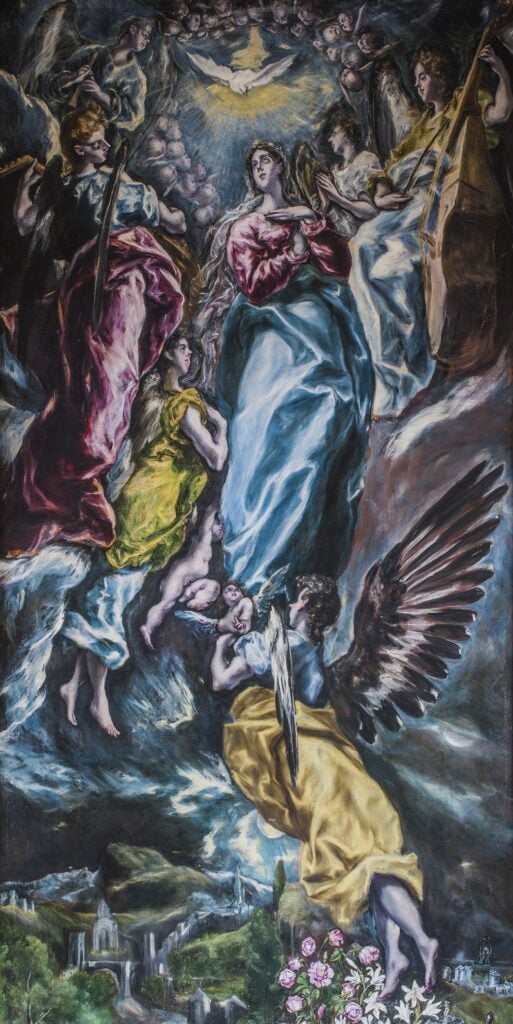
A legend in paint revealed, in emotional, spiritual glory.
El Greco: Immaculate Conception Santa Cruz
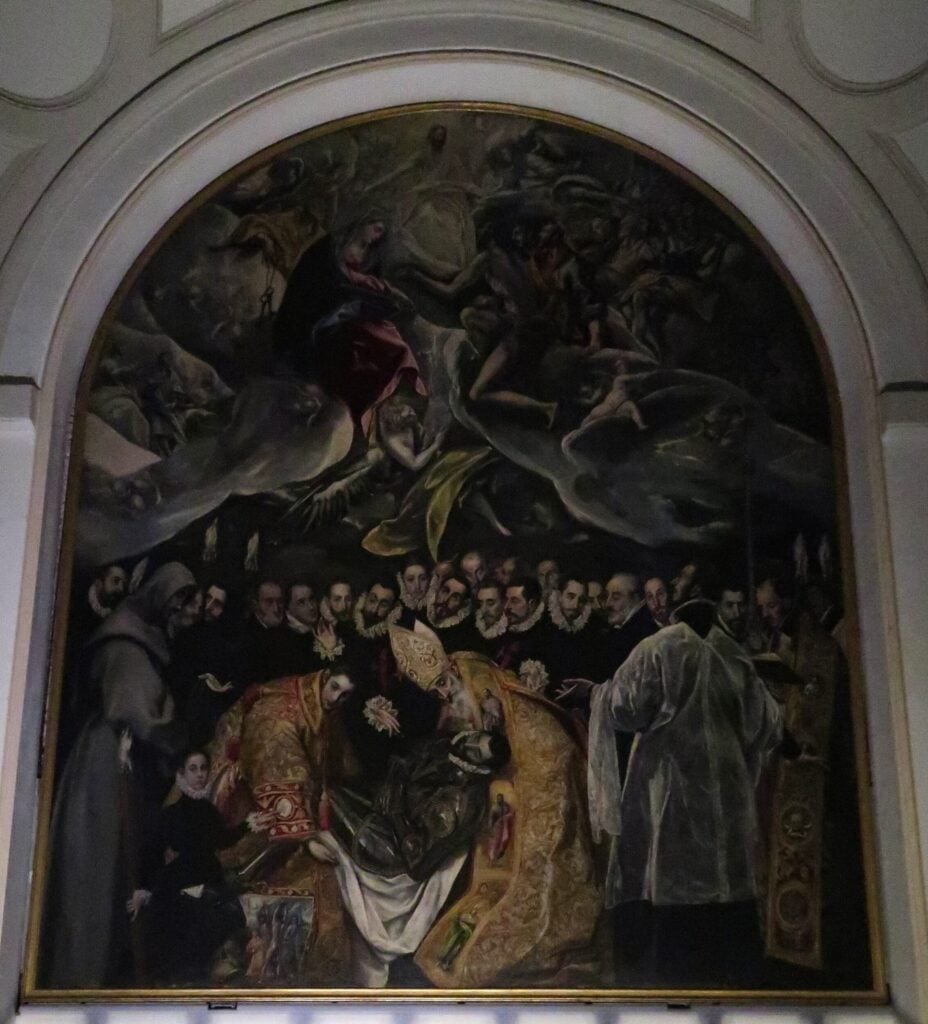
Around the corner from the museum in Iglesia Santo Tomé we find El Greco’s fascinating altarpiece The Burial of the Count of Orgaz. Recognised as the pre-eminent painter in the city, he was commissioned to produce this work in 1586 by the local parish priest. Though he was raised in the Greek Orthodox faith, El Greco converted to Catholicism while in Spain.
The subject matter is a strange one – a pictorial representation of a legend from 1323. Two saints were believed to have descended from heaven to personally bury Don Gonzalo Ruiz de Toledo, Lord of Orgaz as a reward for his exemplary faith. The monumental canvas is divided into two distinct sections, the heavenly and the earthly, differentiated by style and the use of colour.
The upper plane is luminous and filled with light; the intense primary shades a nod to the influence of the Venetian school. Saints and the Virgin Mary surround the central figure of Jesus, their elongated limbs twisting and turning dramatically across its surface, filling every inch of space.
The style changes entirely on the earthly lower plane with a notable absence of colour. Is this a comment by the artist on the superiority of a life of faith? Contemporary Toledan figures form a sombre line, all dressed in muted black robes with white collars. A portrait of the artist is included in the line-up of mourners, while in the bottom left, a portrait of his young son looks directly at the viewer. In sharp tonal contrast, gold and red robes demarcate the two saints who hold the body of the count, his head protruding towards the viewer.
Another worthy collection of the artist’s work can be found to the western side of the city. The Museo de Santa Cruz is worth a visit for its architecture alone, housed in a superb Renaissance building with an ornate staircase, tranquil cloistered courtyard and striking ‘artesonado” coffered ceilings. In addition to works by Goya and Ribeira, the museum has several key works on display by El Greco. The altarpiece of the Immaculate Conception was one of the last paintings ever completed by the artist. His expressionism has reached its full heights in this work; the central figure of Mary surrounded by angels in a swirling mass of colour. In the bottom left corner is a view of Toledo, a nod of reverence to his adopted city.
Though he’d fallen out of favour as an artist by the time of his death, hundreds of years later he is viewed as a precursor of modernism. His distorted stylized forms, rejection of naturalism, emotional intensity and rich colour palette anticipated the Expressionist movement of the early 20th century.
El Greco was buried in a crypt beneath the Monastery of Santo Domingo El Antiguo, which today still houses three of his early works. It’s a fitting resting place – a return to the place of his first Toledo commission.
Supporting young & beginners
Want to give this writer some extra encouragement?
Support a writer breaking out into the literary industries by donating. 50% of the donation goes to the writer, whilst the other half is used to build and develop the Magazine, providing even more opportunities for people.
© 2026 Houghton & Mackay. All Rights Reserved. The content in this publication may not be reproduced in any form without prior permission to the rights owners. Learn more about Houghton & Mackay’s main Business Website. Prose by Karyn Farrell