
By Chris Bennett: Columnist
Cinema has always claimed to celebrate originality, yet some of its greatest achievements have built on someone else’s ending. A sequel is a curious artistic undertaking. It inherits characters it didn’t create, a history it can’t rewrite and an audience that already understands, and possibly even loves, before the opening scene has even begun.
That inheritance creates a question for modern filmmakers and writers. Is the next filmmaker simply another artist, free to reshape the material according to their own vision, or do they assume a responsibility to preserve something that already exists?
Every sequel sits somewhere between those two philosophies, balancing the desire to create something new with the obligation to respect what has come before. This creates a tension between authorship and stewardship that has become one of modern cinema’s defining creative challenges.
The truth is that art has never progressed by refusing to challenge itself. Every generation has inherited the work of those who came before, interpreting it through different experiences, technologies and even cultural values. Shakespeare has been reimagined countless times, often in unrecognisable ways such as in Disney’s The Lion King. Sherlock Holmes has survived more reinventions than perhaps any other fictional character ever has and even mythology, the oldest form of storytelling, evolved as each generation added its own voice to familiar tales. This continues to happen today; one of 2026’s biggest films was Christopher Nolan’s The Odyssey.
There is, then, a compelling argument that a sequel should enjoy the same freedom. Why should a filmmaker spend years developing a personal vision only to become constrained by decisions made years, even decades earlier? If every creative choice is governed by precedent, the sequel risks becoming little more than an exercise in imitation.
The challenge for sequel makers, then, is not to reject originality but to redefine it. A sequel was never intended to offer the same creative freedom as an original work because it is attempting something fundamentally different. It is building upon foundations that already exist, continuing a story that has already begun and inviting audiences back into a world they already know. When that continuation is handled with care, returning to that world feels effortless, as though the audience had never truly left it. When it’s not, the illusion fractures, and the audience becomes acutely aware that they are no longer returning to the same place, but to someone else’s interpretation of it.
Continuation, however, should never be mistaken for stagnation. Audiences don’t return simply to watch familiar events unfold again, unless your name is James Bond. No, usually they return expecting new conflicts, unexpected turns and characters who continue to grow beyond the people they once were. Respecting an established world doesn’t demand repetition; it demands consistency. The rules may evolve but they cannot simply be discarded when they become inconvenient. The world may expand and its inhabitants may change, but those developments must feel like the natural consequence of everything that has come before rather than a rejection of it.
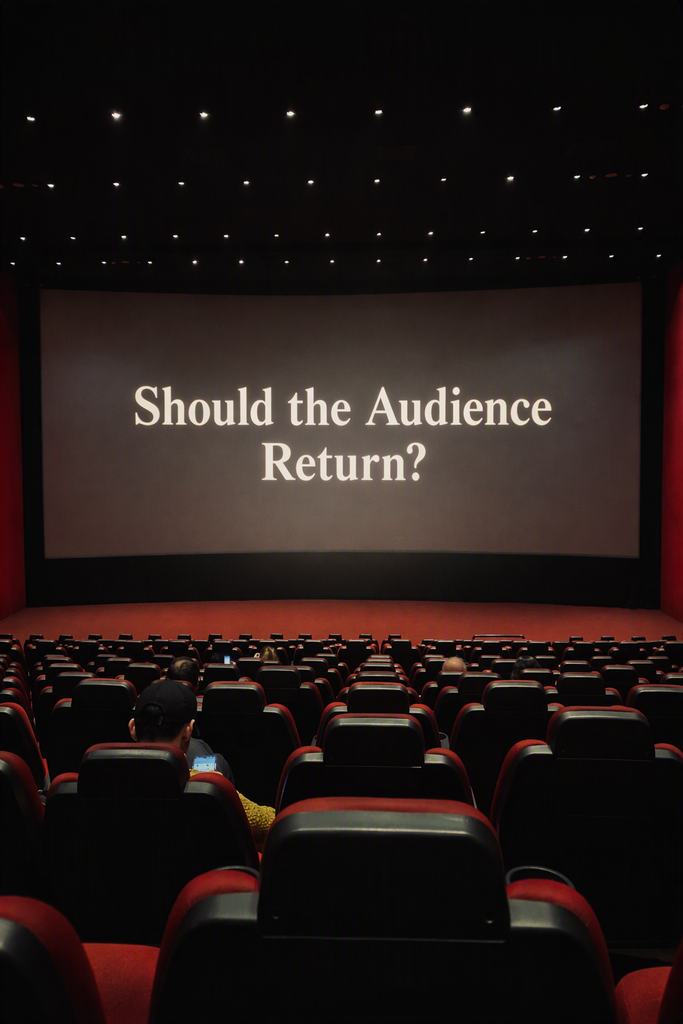
The empty seat has become cinema’s most unsettling character
James Cameron understood this when he made Alien. Rather than attempting to recreate Ridley Scott’s claustrophobic, haunted house horror, he asked a different question: what happens when someone who has survived unimaginable terror is forced to confront it again? The genre changed completely, but the world did not. The xenomorph remained the same terrifying creature on the surface while evolving into more than a single threat into a hive of terror. Ripley’s trauma became the story’s emotional foundation and the rules established by the original film continued to govern every decision. Cameron didn’t replace Alien; he built upon its foundations, proving that a sequel can feel entirely original without ever betraying the world that inspired it.
This is where discussions surrounding canon often become confused. Canon is frequently dismissed as little more than a collection of trivia, maintained by obsessive fans with encyclopaedic knowledge of fictional worlds. In reality, canon serves a far more important purpose. It provides the framework upon which every subsequent story is built. It tells audiences what is possible, what is impossible and, perhaps most importantly, what carries consequence. Every fictional universe teaches its audience how it works.
Whether it’s the Force in Star Wars, the dinosaurs of Jurassic Park or the time-travel paradoxes of Back to the Future, each story establishes its own internal logic. Audiences will accept even the most fantastical ideas, provided those ideas remain consistent. The moment those rules become optional rather than foundational, disbelief is no longer suspended. The audience stops experiencing the world and begins questioning the storyteller.
The consequences of abandoning those foundations can be seen just as clearly. A notable example would be Star Wars: The Last Jedi. Rian Johnson’s effort remains one of cinema’s most divisive sequels, not because it dared to challenge audience expectations, but because many felt it disregarded the expectations established by the saga itself. Iconic characters, most notably Luke Skywalker, appeared to act in ways that disconnected from decades of development, long-standing rules governing the universe were suddenly cast aside in place of dramatic moments designed to surprise in the moment without considering the direction of the story still to come. Whether one admires or dislikes the film, the reaction it provoked serves as a reminder that audiences that are usually remarkably forgiving of bold ideas, are far less forgiving when those ideas appear to disregard the foundations upon which they were built.
It’s about bringing the character forwards…without leaving them behind
Some sequels have earned our trust, others maybe not so much.
Cinema offers no clearer examples of this balancing act than Alien 3 and Blade Runner 2049. Both inherited beloved worlds and devoted audiences. One demonstrated how easily an emotional journey can be undermined, while the other showed how a sequel can deepen a story without ever diminishing what came before.
Another illustration of this would come from a franchise that, as we have said, had previously demonstrated how continuation could be done well. James Cameron ended Aliens by giving Ellen Ripley something she had been denied throughout two films of character development: hope. She survived again, found a surrogate family in Hicks and Newt, and, for the first time since the destruction of the Nostromo, she appeared to have found a hard-earned peace.
Alien 3 opened by taking all of it away.
The decision was not controversial simply because popular characters died. Cinema has never shied away from tragedy. The controversy stemmed from the manner in which those deaths occurred. Hicks and Newt are killed in the opening shots of the film, basically off screen. They are removed from the story before the audience has even had the chance to rejoin, turning the emotional resolution of Aliens into little more than a temporary illusion. The film remained internally consistent, and the film is quite good once it gets going, but it demonstrated another danger facing sequels: respecting the facts of what came before is not always enough. A continuation must also respect the emotional journey that led the audience there.
Fortunately, cinema offers just as many examples of the opposite approach. Denis Villeneuve’s Blade Runner 2049 inherited one of science fiction’s most revered worlds, one built as much upon unanswered questions as definitive answers. Rather than attempting to redefine those questions, Villeneuve explored their consequences. The film introduced an entirely new protagonist, expanded the mythology surrounding replicants and pushed the world decades beyond where audiences had last seen it, yet it never lost sight of the ideas that made the original endure.
Harrison Ford’s return as Deckard is perhaps the film’s greatest act of restraint. He remains central to the story without becoming its purpose. His past is neither rewritten nor diminished to create fresh drama. There is no ‘kill the past’ message here. Instead, the film informs every decision made by the new generation of characters as a consequence of the search for the old. The audience is never asked to reconsider what they already know, only to understand it more deeply.
That is the quiet strength of a successful sequel. It does not compete with the story that came before, nor does it seek to replace it. It recognises that every chapter gains meaning from the ones surrounding it. The original film remains unchanged yet somehow feels richer because another story has been told beside it, rather than over it.
Taken together, these films reveal that audiences are reasonably consistent in what they ask of a sequel. They don’t demand familiarity at the expense of originality, nor do they expect innovation for its own sake. They ask for something considerably simpler, yet more difficult. They ask to believe that the world they have returned to is still governed by the same truths that persuaded them to invest in it in the first place.
That trust is not earned through references, callbacks or nostalgic cameos. Those are embellishments, not foundations. Trust is earned through consistency. It comes from knowing that actions still carry consequences, that characters remain recognisably themselves even as they change, and that the rules of the world continue to matter regardless of who now occupies the director’s chair or the writer’s room.
Some would argue that audiences often mistake nostalgia for quality, treating canon as something sacred rather than something useful. There is truth in that criticism. Fan communities can become possessive, resisting change simply because it’s change. But that is not the argument being made here. After all, the whole reason making a sequel is attractive to a studio is the passion, and therefore profitability, that fans show to their beloved world. Disney didn’t buy Lucasfilm for billions because the fans enjoy lightsabers. It acquired Lucasfilm because generations of audiences had already invested emotionally and financially in Star Wars and Indiana Jones. Without the fans buying the merchandise and cinema tickets, there would be little commercial incentive for studios to make sequels at all.
Perhaps this is why discussions about canon are so often misunderstood. Canon is not a list of events to be memorised or protected for its own sake, regardless of what the historians of any given fandom might have you believe. It is the accumulated history of cause and effect within a fictional universe. Remove that history, ignore its consequences or rewrite its meaning, and the audience loses more than continuity. They lose confidence that the story they are watching still belongs to the world they fell in love with. Sequel makers must respect that at all costs. A sequel that forgets that might still entertain. It may even succeed commercially. But it’s a risk, because without respect, an audience will likely reject a film.
Ultimately, that is the responsibility of every sequel. Not to repeat the past, but to honour it. The greatest continuations understand that originality and respect are not opposing forces. They are partners. The finest sequels do not ask audiences to abandon the world they know. They invite them to discover that it was always capable of telling another story. Perhaps that is the greatest compliment any sequel can receive: not that it surpassed the original, but that it made the original feen even richer than it did before.
© 2026 Houghton & Mackay. All Rights Reserved. The content in this publication may not be reproduced in any form without prior permission to the rights owners. Learn more about Houghton & Mackay’s main Business Website.