By Ivelina Koseva: Columnist
A monster and its taming – a story old as time, is an epic human quest told in art, myth and battle. For thousands of years this endeavor has been confronting us with the same fundamental questions: “Do monsters and men belong to different worlds or are they part of the same realm? Is the monster inside a thing , is it even part of the same dual human being?”
It’s about exploring how the answers to these questions have been evolving across the ages of art history. It serves as a short travel guide through the Romantic and Post-Romantic strive for victory over evil and the redemption of self.
“When ribbon grass is pulled-up, the sod comes with it. Each according to its kind.” – an ancient Chinese I Ching wisdom goes. Something similar happens when you pull up the root branches of video games in the great arc of Western art. Following that thread one starts a magical and shadowy journey back in time through fantasy movies, dark-romantic literature, post-romantic paintings, and finally – across the fear-abiding reality of the gothic era, where monsters and men still walked apart in separate domains. Almost a millennium earlier, as weird as it may sound, there lived the first “millennials”, and they weren’t actually popular with their ethics, nor were they keen on empathy or mindful of diversity issues. Free speech wasn’t endorsed, free life wasn’t a right. Art was functional and religiously constrained.
“The greatest transformation in art history was not the changing face of the monster, but the realization that it belonged to the same world as man.”
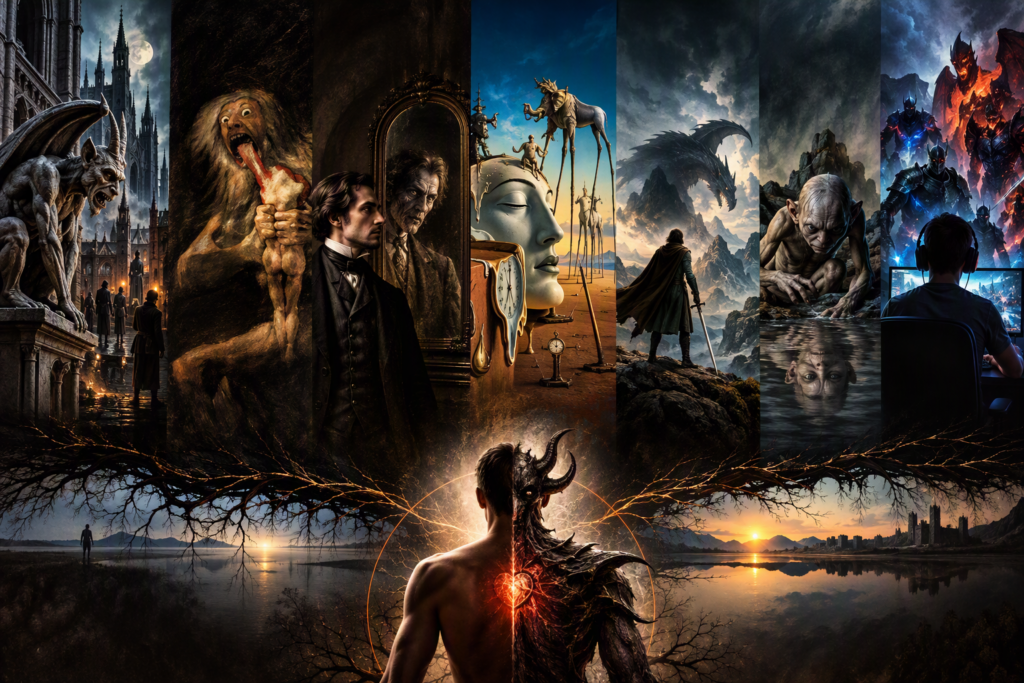
Ancient apparitions, ancestral secrets, shadowy mists veiled their landscapes of terrifying towers and cathedrals. Gothic culture had provided housing for dark forces unimaginable and monsters of lands known and unknown. Humanity had long suffered the middle-age inheritance of hardship and cruelty, placing blame more often on banshees, gargoyles, demons and ghosts than on living men.
Fear had its own architecture. Humans were viewed as observers, or mere victims, helpless to oppose the forces of evil. Like small children who needed the protection of their father, humans fled danger mostly by conforming to the status quo of the dark ages. It was real slaughter and torture for those who didnt agree with it. And yet – monsters were only depicted as building ornaments and hellish creatures sent to punish the sinners and transgressors by invisible law and order.
This collective shadow, as C.G. Jung coined the term, was the one of an oppressor during the Gothic existence. Its monstrous dominance evolved from waging the so-called holy wars into starting the revolution wars during the 18th century. The Age of Enlightenment had given faith a secondary rulership and had brought pure logic to the world of men. The spiritual bypass of the Middle Ages became clearly visible.
It was quite obvious that no banshees, nor witches were punishing men for their crimes. No gargoyles were fighting in these meadows and lands. It was real humans on both sides of the war. Men, gone deep in survival mode, fought like beasts. No laws, no justice, no human connection, no accountability for human actions. Like many other artists and writers at the time, Goya, the famous painter, felt crushed by the observed evilness, helplessness and desperation.
Continued below…

Grieving for humanity, oppressed by aging and presumed psychological breakdown, he started depicting the darkness of the human soul – or the monster inside. His “Black Paintings” (1820-1823), all 14 in count, were born at a time when life had lost its purpose and future had lost its meaning. Were men devouring their own children? Was madness driving them? Was, perhaps, God’s wrath punishing them? Or were their hearts corrupted so by lust and power that they fought fiercely to destroy life as if it didn’t matter?
Those kinds of questions were the ones Goya asked in his post-romantic era. Yet his archetypal paintings full of human brutality, occult horror and religious satire, revealed that the monster inside was mythologized, heavily judged and explored as purely grotesque, and out of this world.
Did humans actually belong to the dark world of war? Was that horror of the revolutionary wars in reality the revolt of the coming-of-age humanity, in its quest for liberation from ruthless authority? People were indeed stepping forth to declare their empowerment, and loudly.
In the later 19th century the monster seemed to develop a bit of a different persona. A corrupted bloodline, a haunted house, a possessed soul, a mad mind. Fiction pieces like Frenkenstein of Mary Shelley (1818) had come a bit earlier to give horror a new land to live on. Dracula by Bram Stoker (1897), The Picture of Dorian Gray by Oscar WIlde (1891), The Strange Case of Dr Jekyll and Mr Hydeby R.L. Stevenson (1886), all of them sparked the flame of curiosity for the monster’s true origins. Now visible, well lit, and set in focus, the monster was undeniably seen “inside”, and the human was finally viewed as dichotomic.
The Jungian collective shadow had returned, demanding attention and as a result, had been acknowledged as innate. Art and science together mirrored that acknowledgement marking the emergence of psychoanalysis in the end of the 19th century. People, as divided selves, got to express a new forte – accountability for their beastly actions. If the monster was within, maybe it was controllable and maybe it belonged to the human world. Dark romanticism had established that humans were creatures of contradiction but still carried on the same old human wound – the lack of belonging. It asked: Are people Dr. Jekyll? Are they Mr. Hyde? Are they both?
Julie Eshbaugh: If I told you monsters could be tamed, would you want to live with monsters? Even a tame monster is still a monster“
Entering the 20th century on the map of art history, obsessed with Freud and ready to break all rules of painting,here came Salvador Dali. His mesmerizing and bizarre beasts were surrealistic manifestations of psychological perplexities. “The inventions of the Monsters” (1937) was painted right on the verge of WW2. Dali himself had explained about his motivation to paint it: “According to Nostradamus the apparition of monsters presages the outbreak of war.”
The same monster of war had come back, the same wound had emerged. But now the monsters had human faces, as Dali had stated clearly : “Horse women equal maternal river monsters.Flaming giraffe equals masculine apocalyptic monster. Cat angel equals divine heterosexual monster. Hourglass equals metaphysical monster. Gala and Dalí equal sentimental monster.” (https://www.artic.edu/artworks/151424/inventions-of-the-monsters)
Was Dali searching hope into dreams just as Goya had searched safety into myth? Was Cronos, the god of time, morphing into dripping clocks and desert skulls? Did the monster belong to dreams? To fantasy? To the subconscious? Was this its real domain?
In his seminal work “The Hero with a thousand faces” (1949) Joseph Campbell introduced the “monomyth” or his concept of the “Hero’s journey”. It seemed that there humanity had finally seen where the real empowerment lies – everyone was the Hero, every journey was a journey of becoming, of meeting the monster inside, of battling the monster, and liberating from servitude. It could be viewed as a journey of maturing, where one became an adult, and in adulthood one became free. Consequently, in freedom came the responsibility to choose freely and act responsibly. Did men choose to be monsters or men? Were they free to choose where to belong? Around that time, in his epic fantasy novel LOTR (first published 1954) J.R.R. Tolkien described Gollum, a creature of monstrous essence who used to be human but his heart had been corrupted by the mighty One Ring. Based on the books, directed by Peter Jackson, the groundbreaking cinematic trilogy was first released in 2001 and Gollum gained his famous frog-like ragged and rotting looks.
A creature of two personas, Gollum often remembered Smeagol, or the human he used to be before his mental and physical decay. Fantasy beautifully portrayed how a transformation is possible from one into the other, and how, therefore, the opposite might also be true. Yet, did humans remain bound to only one of the two extremes? Following the industrial revolution, the cognitive revolution of the 1950s marked the conception of AI, implying that artificial intelligence was to become the future of mankind.
Science fiction and the birth of the computer has laid the foundations of the internet era, and consequently- video games, as the last known post-romantic phenomenon of our time, where entertainment met art. The more dry and logical a culture had become, the more moist and chaotic the opposing movement came back. Spanning across continents, video games had become the sacred wings of the valerians, the mythic ships of the Greek gods, the high-tech spacecrafts of alien races, you name it. In other words, video games had become, for many, vehicles for escaping the burdens of reality.
Post-apocalyptic games like The Last of Us (2013) – see our article on this, or The Walking Dead (2012) explored different case-scenarios: “What would happen if the monsters finally came out…and had consumed us all?”
Withdrawing into video games, humans could disconnect from the environment and process complex pain. They could do that by diving deep into different roles, especially the role of the savior, or the victorious conqueror. They could disperse themselves into the dark and mysterious realms of Diablo (1997), Dark Souls (2011), Bloodborne (2015), etc. to experience the Hero’s journey: the adventure of fighting for a cause, saving the world, transforming the shadow, winning the epic final boss battle and stating a choice of belonging.
Maybe this is therapy , maybe this is escape, the truth is- no one has answered the question: “If “the hearts of men are easily corrupted”, as the Elf-queen Galadriel narrates in the famous prologue of the Lord of The Rings: The Fellowship of The Ring (2001), where do humans belong? Where do monsters belong if they are part of the human self? Or maybe, is it a matter of maturity to equilibrate the human with the beast?
Comics and movies in the 21st century continue the eternal battle of monsters and men and most often present entities that are a combination of both. Take Hellboy, whose fans celebrate on the upcoming 5th of October. Half-demon, half-man, born in the middle ages but summoned in 1944, he strives to find his own belonging in the world of men while gradually integrating his ancestral heritage of being the descendant of both a demon and a witch.
Now, also turning to the (comic books and movie) character of Spiderman, who has recently matured into an adult in the “Spiderman: Brand New Day” movie (2026) , there is a direct statement on the matter. When asked if he was the monster or the man, he answered : “I am both”. And that reference shows the exact relevance between becoming an adult on the inside, psychologically maturing and finding the feeling for belonging where it actually lies. Right here, the wound has been processed and the answer has been accepted. The quest now need not be anymore the search for belonging but for the next evolutionary step for humanity which is…?
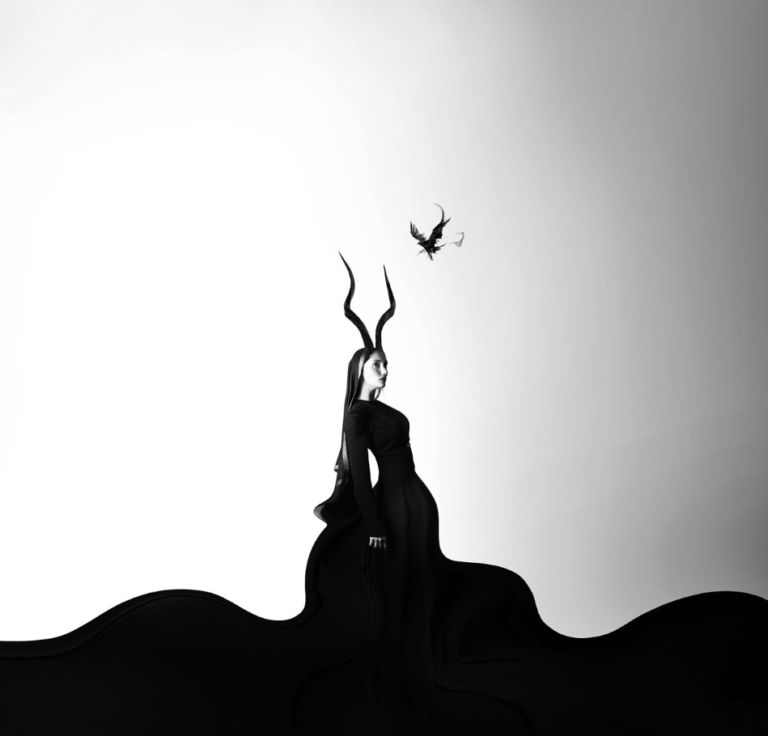
© 2026 Houghton & Mackay. All Rights Reserved. The content in this publication may not be reproduced in any form without prior permission to the rights owners. Learn more about Houghton & Mackay’s main Business Website. Cover image by Vilkasss, Top Magazine Cover by Marjan Taghipour
like this article? vote for the author below