WHERE CLASSICAL MEETS
CONTEMPORARY VISION
By Evan Meikle: Columnist
Skopje, North Macedonia, a rarely visited capital just north of the Greek border and nestled beneath the imposing Vodno Mountain, is a one-of-a-kind city, one defined as much by its ancient past as by the tumultuous years of the 20th and 21st centuries.
In truth, North Macedonia and its first city are mostly unknown qualities to much of the world; a great shame, given the country and capital’s fascinating culture, history, and architecture.
First off, the mountainous North neighbour of Greece is of course home to the greatest of historical greats, the eponymous Alexander of Macedon. Now, whilst this is a contested topic with both southern Balkan nations claiming the ancient icon, that can be a topic for another day.
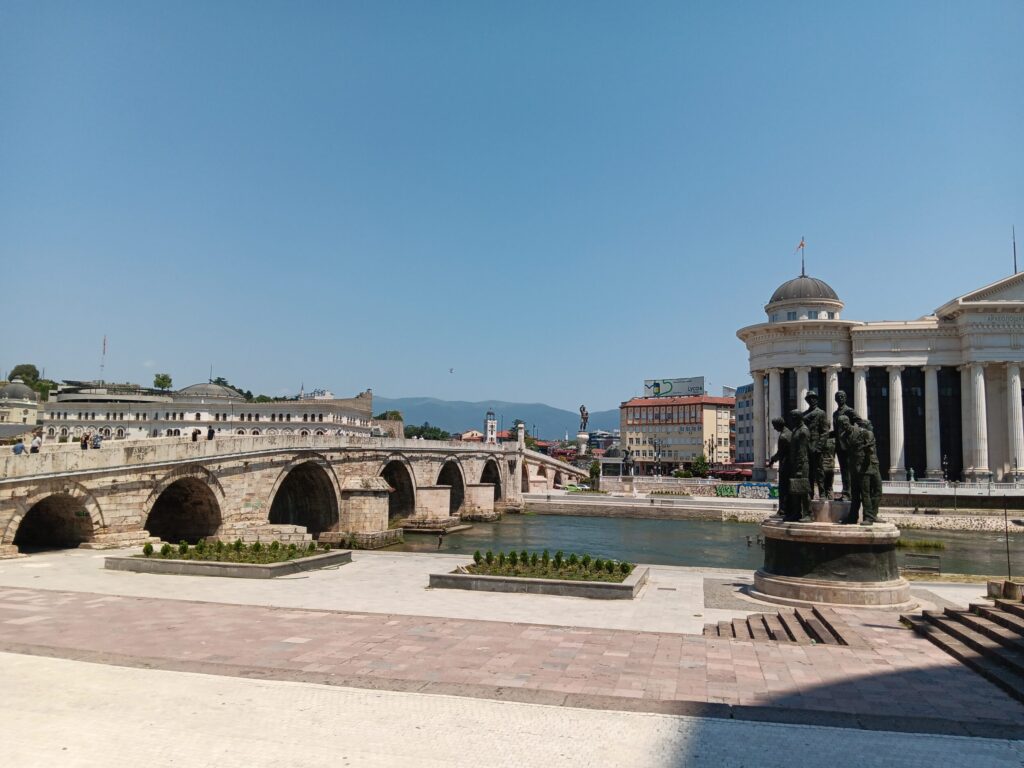
However valid their claim of exclusive rights to Alexander, Skopje proudly, and frequently, displays him and his lineage in towering statues and faux-Greco-Roman busts which populate the city’s streets, squares, and riverfronts
In fact, much of the capital’s very centre is a bizarre yet undoubtedly impressive nexus of uncannily ancient architecture. With gleaming marble promenades, innumerable stone busts, and brilliant facades displaying, in very clear terms, the glamorous and long-stretching history of the region.
However, all this glamour and all the allusions to grandeur that it conveys mask something altogether different, and much more recent.
Continued below…
“Skopje is a city where history stands in stone, yet the warmth of its people softens every edge.”
“… they rebuilt Skopje from generous foreign donations. The message sank in: foreigners love disasters… calamities became an export industry.”
In 1963, over two millennia on from Alexander the Great’s continent-spanning empire, after centuries of foreign rule first by Romans, Byzantines, Ottomans, and Soviets, the city that became Skopje suffered a devastating ecological rupture. An earthquake, registering a 6.1 magnitude, shook the city for 20 seconds. 20 seconds, which not only destroyed around 80% of its buildings and infrastructure, but also claimed the lives of over 1,000 of its citizens.
The process of reconstruction was completed swiftly, hoping to offer Skopje’s residents the quickest return to normality, but also in keeping with the architectural vogue of the 1960s in the Eastern Bloc, modernism.
However, the era of modernist style and architecture came and went, and tastes soon turned against its bleak and abrasive tendencies.
Therefore, in 2010, the Macedonian government announced ‘Skopje 2014’, a program of radical redevelopment that sought to restore beauty and national pride to the capital.
Here began the development of Skopje’s current arresting appearance. Adopting the policy of ‘Antiquization’, the ruling VMRO-DPMNE party underwent the process of giving the capital city the appearance of an ancient metropolis, fit with the white stone trimmings and bronze embellishments. This meant installing new bridges across the River Vardar, each decked with dozens of sculptures, as well as cultural buildings, including an orchestra hall, government ministries, museums, and a national theatre. Furthermore, the facades of many structures were to be revamped with a neoclassical style, aiming to integrate existing structures into the policy’s aesthetic ambitions.
This radical refacing of not the composition but the entire appearance of the city centre was ready means for contestation in and of itself; however, further critiques began emerging concerning the intent and consequence of the otherwise benign proposal.
These criticisms have taken a variety of forms, from claims that it was too expensive and a vanity project in place of systemic social change, to perceptions that it presented a monoethnic narrative of classical European-ness within a diverse multiethnic nation, or that it risked provoking further tensions with the Greek neighbours.
Most of all however, the radical project, for all its attempts at restoring national pride, establishing a connection between a people and its history, for its ambitions on building a national identity after centuries of subjugation, suffered from the simple critique of kitsch, style over substance, and resembling a weak counterfeit of authentic European architectural culture.
Now it is important to acknowledge that this view is not shared by all and, indeed, many saw and continue to see the structures created by Skopje 2014 as welcome symbols of artistic patriotism and masculine pride in the region’s undoubtedly grand history.
Further, the project’s goal to increase appeal for foreign tourists has been largely successful, with tourism increasing drastically year-on-year since 2014 (with the notable exception of 2020). In this sense then Skopje’s redevelopment has had its fair share of demonstrable success. But, in 2026, over a decade on from the completion of the project, how should Skopje’s ancient facelift be understood?
Beyond all of the political and historical implications that have legitimately occupied the discourse, any judgment ultimately comes down to a simple question of taste.
As the style of central Skopje’s visage has undergone such drastic change over its century-plus of shifting political contexts, preference over aesthetic, with all its associations, has naturally become divided. In this sense, Skopje 2014 was always doomed to result in controversy as it reflected a nation continuously unsettled by seismic social transformations.
Foreigners, then, without the inbuilt cultural connection to events in North Macedonia’s modern history, can only begin to understand and judge its latest, and most visible, sign of change by simply seeing it for themselves. North Macedonia is a fascinating country, with an intrigue reflected best through the remarkable appearance of its capital’s city centre.
So visit; cross the Varda on the baroque arched bridges and soak up the imposing statues of national icons, but once you’ve done that also take a walk north of the river and see the Skopje of old in the Old Bazaar. Explore its cobbled streets and sit for a while in one of the dozens of coffee or baklava cafes dotted throughout.
Then, once you’ve had your fill of the eastern and old, experience the brutalist Saints Cyril and Methodius University and possibly even admire the striking Central Post Office in all its asymmetrical concrete glory. Somewhere between these three ideas lies the real Skopje, an unusual and fascinating country at the heart of so much history yet all-too forgotten today.
Supporting young & beginners
Want to give this writer some extra encouragement?
Support a writer breaking out into the literary industries by donating. 50% of the donation goes to the writer, whilst the other half is used to build and develop the Magazine, providing even more opportunities for people.
© 2026 Houghton & Mackay. All Rights Reserved. The content in this publication may not be reproduced in any form without prior permission to the rights owners. Prose and photography by Evan Meikle Learn more about Houghton & Mackay on the main Business Website.